
Operating Environment Misalignment
Consider a common scenario. A company invests heavily in a leadership-development program for its managers. The vendor is credible. The curriculum is well-designed. Feedback scores after each module are strong — participants describe the sessions as engaging, relevant, even transformative.
Eighteen months later, the metric the program was designed to move has not shifted. The same managers who scored the workshops highly are running their teams exactly as they did before. Several have mentioned, informally, that the ideas were good but “didn’t really apply” to how things actually work here.
This is not a story about a bad program. It is a story about a question that was never asked before it started: what, specifically, in this organization’s operating environment would change to let the new behavior survive contact with daily work?
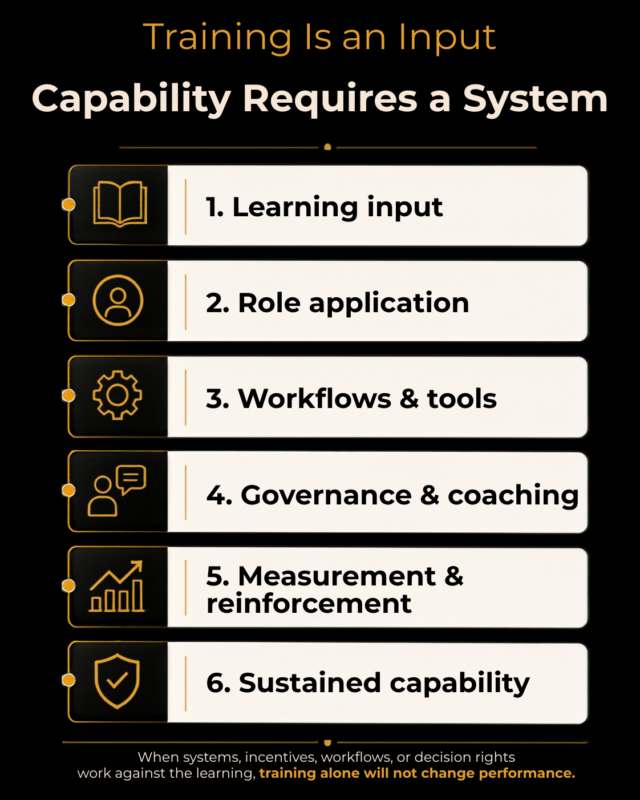
Training alone does not build organizational capability because knowledge is only one component of performance. New behavior must also be supported by decision rights aligned to the new expectation, an operating environment that rewards rather than punishes the change, direct-manager reinforcement, and a measurement layer that tracks whether the behavior is actually appearing. Without those conditions, people return to the same environment and reproduce the same patterns — regardless of how good the training was.
Key takeaways
- Training delivers knowledge; capability is behavior under real conditions — they are not the same, and the budget leaks in the gap between them.
- Training transfer fails for four structural reasons: decision rights that never moved, an environment that punishes the new behavior, no measurement layer, and managers who were never equipped to reinforce it.
- Real capability needs four layers run together — training, operating-environment redesign, accountability and measurement, and manager enablement.
- Before commissioning another program, a leadership team should be able to answer five questions in writing.
The Capability Illusion
Most organizations use “training” and “capability building” as if they mean the same thing. They do not, and the confusion is where the budget starts leaking.
A manager can leave a negotiation workshop able to explain four tactics in a debrief and still walk into Monday’s vendor meeting using the same posture they have used for ten years — because nothing in their environment changed except what they were told to do differently. The vocabulary improved. The behavior did not.
Harvard Business Review examined this pattern in a detailed analysis of why leadership training programs fail. Its conclusion: organizations spend heavily on employee development, but people return to the same operating conditions and revert to established ways of working. The root cause is not curriculum quality. Organizational design and managerial processes must be addressed before training can produce sustained results.
McKinsey’s research on capability building reinforces the problem from the measurement side. More than half of surveyed organizations either had not set quantitative targets for their capability programs or did not know whether those targets had been reached. Only 13 percent of respondents said their organizations calculated quantifiable returns on learning investments. One in five did not measure the impact of their learning programs at all. These are not figures from organizations that didn’t invest. They are figures from organizations that invested and still could not show what changed. The money converted into activity, not capability.
of organizations set no quantitative targets for capability programs — or did not know if they were met
calculated a quantifiable return on their learning investment
(one in five) did not measure learning impact at all
Sources: McKinsey, Building Capabilities for Performance; Gallup workplace research.
Four Structural Reasons
When a program produces strong feedback scores but no behavioral or business outcome, the cause is rarely the content. It is almost always one or more of these four structural conditions:
- Decision rights haven’t moved with the training. You can teach a regional manager to make faster, more autonomous decisions — but if every meaningful call still has to travel up two layers for sign-off, the training has equipped someone for a job they don’t actually hold. The skill and the authority are mismatched, and authority wins every time.
- The operating environment punishes the new behavior. If a newly trained team lead starts delegating more — exactly as the program recommended — and is then penalized in a performance review for “not being hands-on enough,” the lesson the organization just delivered, unintentionally, is: don’t do what we trained you to do.
- There is no measurement layer for the actual capability. Most organizations measure attendance, satisfaction scores, and occasionally a knowledge-check quiz. Almost none measure whether the targeted behavior is showing up in meetings, decisions, or customer interactions three months later. What isn’t measured doesn’t get managed — and what doesn’t get managed quietly disappears.
- Managers are not equipped to reinforce what people learned. Direct managers are the single most important variable in whether new behavior survives after a program ends. Gallup’s research found that managers account for roughly 70 percent of the variance in team engagement. In a separate Gallup study on barriers to employee development, less than half of managers globally had received any formal training on how to lead, coach, or reinforce behavioral change in their teams. Asking an untrained manager to sustain a new behavior is asking them to model something they were never prepared to do.
Independent peer-reviewed research published in 2024 in the European Journal of Work and Organizational Psychology examined 541 employees who had undergone workplace training. It found that transfer to the job was materially influenced not by content quality but by the conditions surrounding the learner — specifically supervisor and peer support after the training ended. The quality of the learning was not the variable that determined whether it transferred. The environment people returned to was.
None of these are content problems. All four are operating-environment problems.
What Real Capability Building Requires
If training transfer fails for structural reasons, building real capability requires structural redesign — not a better workshop. Four layers are needed, and skipping any one of them turns the investment in the other three into a sunk cost.
Exhibit — the four layers of a capability system, run together rather than in sequence.
Layer 1 — Training. Still necessary. People need a shared frame, a vocabulary, and an opportunity to practice before they are expected to perform. This is the layer most organizations already do reasonably well.
Layer 2 — Operating-environment redesign. Decision rights, escalation paths, meeting structures, and approval thresholds need to be examined and, where necessary, rebuilt so the new behavior has somewhere to land. This is the layer almost everyone skips, and the one that determines whether the other three matter at all.
Layer 3 — Accountability and measurement. Define, in advance, what the targeted behavior looks like when it is working — and build a simple way to observe it within the first 90 days. This does not require a new HR system. It requires deciding, before the program starts, what evidence will tell you it worked.
Layer 4 — Manager enablement. Equip the direct managers — not just the participants — to recognize, coach, and protect the new behavior when it appears. This is frequently the layer that is missing entirely. A manager who cannot reinforce a new behavior will, often without realizing it, extinguish it.
This layer connects directly to the broader work of OD and capability development and sound HR governance: accountability structures and manager practices need to be designed for transfer, not assumed to happen automatically.
Run all four layers together, and training becomes the front end of a capability system rather than a standalone event.
This is the logic embedded in ROSH’s execution framework: sustainable execution depends on the interaction between clarity, operating design, measurement, and human capability — not on any single intervention. Run only the first layer, and the result is an expensive seminar.
When Training Needs an Operating Environment
To illustrate how the four layers interact in practice, consider the following hypothetical scenario.
Suppose an organization invested in a leadership-development program for its branch managers. Feedback was positive. Eighteen months later, however, managers were still escalating routine operational decisions to head office, adding four to six days to issues they were already authorized to resolve independently under the organization’s own policy.
A diagnostic of the operating environment might reveal three conditions working against the training already delivered.
First, the internal workflow system still routed every decision of that type to head office by default, regardless of the stated policy.
Second, branch managers’ scorecards rewarded zero escalations returned for rework. The safest career move was therefore to escalate almost everything.
Third, regional directors had never been aligned around what good decision-making looked like under the new model. They continued requesting the old reports and approvals, unintentionally reinforcing the behavior the organization wanted to change.
In this situation, the intervention should not begin with another workshop. It should begin with the operating conditions.
The routing logic would be corrected to reflect the stated policy. Scorecards would be redesigned around decision quality and resolution speed rather than escalation avoidance. Regional directors would receive a structured briefing on the behaviors they needed to recognize, protect, and reinforce when managers acted independently.
Assume that, within one quarter, average resolution time for the targeted decision category fell from five days to under two. The point is not the specific number. The point is the mechanism. The earlier training may have given managers relevant knowledge and skills, but the organization had not created an environment in which those capabilities could be applied consistently. Once the operating system changed, the learning finally had somewhere to land.
ROSH builds all four layers into a single engagement — not a sequence of disconnected projects.
Five Questions to Ask Before Commissioning Another Training Program
Before signing off on a capability investment, a leadership team should be able to answer all five of the following in writing, before the program is designed:
- What operating metric will actually shift if this training works — and by when?
- Who has the authority to act on the new behavior once people are trained in it?
- What will we measure, in the first 90 days, to know whether the capability is sticking — not whether participants found the session useful?
- What does the direct manager need to do differently for this behavior to survive, and have they been prepared for that role?
- What in our current environment would cause this change to revert within six months — and have we addressed it before day one?
If a leadership team cannot answer all five with specifics, the organization is not ready to buy training. It is ready for a diagnostic-to-implementation arc that answers these questions first and designs the program around what the answers reveal.
The Bottom Line
Training is not the problem, and it is not optional — it remains layer one of four. The problem is buying it as if it were the whole system. Capability is built in the operating environment as much as in the classroom, and any leader who wants the next investment to actually shift a number needs to be designing for all four layers from the outset, not discovering the structural gaps eighteen months later.
If you are weighing a capability investment and want to understand what would actually need to change for it to produce results, contact ROSH.
Frequently Asked Questions
Harvard Business Review identified this as a persistent structural problem: organizations invest heavily in training but see limited behavioral or business improvement because people return to the same operating conditions and revert to established ways of working. The issue is not curriculum quality — it is the absence of the four conditions required for behavior to actually change: decision rights aligned to the new expectation, an environment that supports rather than punishes the change, managers equipped to reinforce it, and a measurement layer that tracks whether the behavior is appearing. Effective capability building consulting addresses all four, not just the learning design.
Training delivers knowledge — frameworks, vocabulary, and practice in a controlled setting — while capability is the ability to apply that knowledge under real working conditions, including incomplete information, competing priorities, and a performance system that may still reward the old behavior. Capability building consulting treats training as one of four required layers, alongside operating-environment redesign, accountability and measurement, and direct-manager enablement. An organization can deliver excellent training and produce no capability gain if the other three layers are absent. The distinction matters because it changes what leaders should budget, design, and measure for from the start of a program, not at the eighteen-month review.
A leadership team can test this before committing budget by answering five questions in writing: what business metric the training is designed to shift, who has the authority to act on the new behavior, what will be measured in the first 90 days beyond satisfaction scores, what the direct managers need to do differently, and what in the current environment could cause the change to revert. If these cannot be answered with specifics, the organization needs a diagnostic before it needs a training program. This upfront discipline is central to effective capability building consulting — the conditions for transfer must be designed in advance, not investigated after the results disappoint.
Sources and Further Reading
- Beer, M., Finnström, M., & Schrader, D. (2016). Why Leadership Training Fails — and What to Do About It. Harvard Business Review.
- McKinsey & Company. Building Capabilities for Performance.
- Gallup. How to Improve Employee Engagement in the Workplace.
- Gallup. Addressing the Barriers Blocking Employee Development (2024).
- Roodbari, H., et al. (2024). How to maximize the impact of workplace training.
Make the next capability investment the one that sticks
If your last capability investment did not produce the outcome it was designed for, contact ROSH for a structured conversation about what would need to change for the next one to stick.