
A PRACTICAL DEFINITION FOR SENIOR LEADERSExecution Enablement: Turning Strategy Into Consistent Performance
Most organizations that struggle with performance have a strategy. Many have invested heavily in training. A large number have gone through restructuring. In many organizations, the remaining problem is not the absence of plans or programs. It is the absence of operating conditions that allow the strategy to translate into consistent action.
This article defines execution enablement, explains how it differs from other consulting disciplines, and describes the conditions under which it produces measurable results.
What Is Execution Enablement?
Execution enablement is the practice of diagnosing and redesigning the organizational conditions — clarity of direction, capability to act, operating design, and measurement systems — that determine whether a defined strategy produces consistent performance. It operates at the level of the organizational system, not the individual, and it is most relevant when a sound strategy exists but the operating environment has not been designed to support it.
THE PROBLEMThe Problem Execution Enablement Addresses
Strategies fail for two distinct reasons. Some strategies fail because they are weak — the market diagnosis was wrong, the priorities were not clearly defined, or the required resource commitments were never made. Other strategies fail despite being sound because the organizational conditions required to carry them out in daily practice were never aligned with the strategic intent.
Execution enablement is designed for the second problem.
The research evidence is instructive on both counts. A 2017 Harvard Business Review article by Ron Carucci cited a 2016 estimate that 67% of well-formulated strategies failed due to poor execution — suggesting that strategic quality alone is not a sufficient explanation for performance shortfalls. Paul Leinwand and Cesare Mainardi, in their 2016 book Strategy That Works, reported that two-thirds of surveyed executives did not believe their organizations had the capabilities to execute on their defined strategies. And a 2024–2025 McKinsey survey found that only 21% of executives reported their strategies passed four or more of McKinsey’s Ten Tests of Strategy — a 40% decline from fifteen years earlier.
These findings do not all point to the same problem. The McKinsey data suggests that strategy quality itself has deteriorated, meaning many organizations may need to resolve fundamental questions of strategic direction before any execution-system intervention will be effective. The Carucci and Leinwand findings suggest that even organizations with reasonable strategic clarity routinely fail to build the operational infrastructure needed to act on it.
The distinction matters. Execution enablement addresses the second problem: the gap between a sufficiently clear strategic direction and the operating system’s ability to deliver it consistently. It is not the right starting point when the strategic direction remains unresolved.
DEFINITIONA Working Definition
Execution enablement is the practice of diagnosing and redesigning the organizational conditions that govern how strategy translates into consistent daily action.
At ROSH Business, that work is organized around four conditions, which correspond to the ROSH Framework:
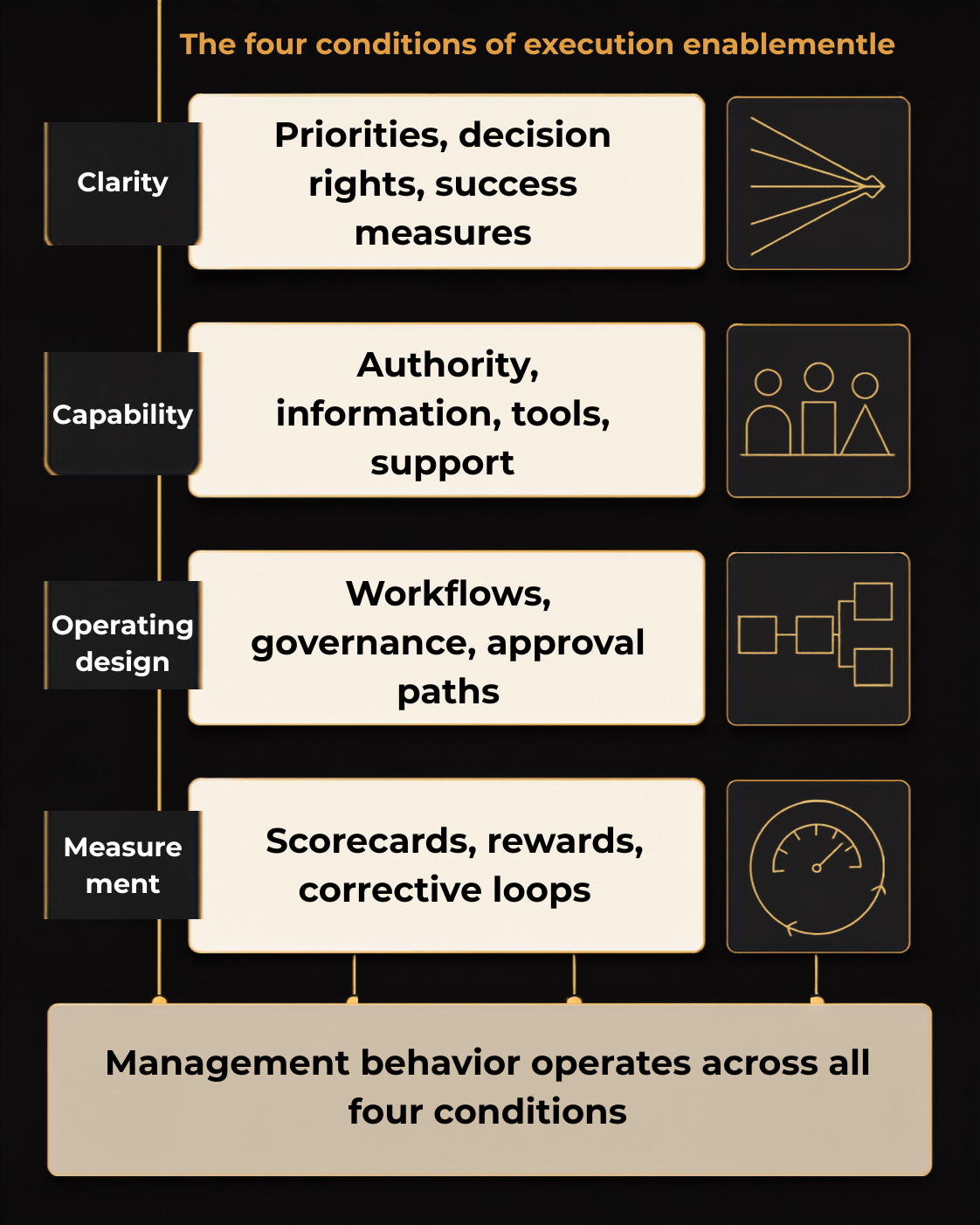
The Four Conditions
Source: the ROSH Framework.
Management behavior operates across all four conditions. What managers review, reward, escalate, tolerate, and correct determines whether formal systems translate into real operating practice. Execution enablement, as a practice, must engage the management layer — not only to build management knowledge, but to redesign the managerial role as it operates within the new model.
Article 1 in this series — Why Training Alone Doesn’t Build Organizational Capability — addresses the Capability condition in detail and explains why learning interventions, when delivered without operating-system alignment, frequently fail to produce sustained behavior change.
ADJACENT DISCIPLINESHow Execution Enablement Differs From Adjacent Disciplines
Because execution enablement is not yet a widely standardized term, it is worth clarifying how it relates to the consulting and organizational disciplines most commonly invoked when performance problems arise. The table below describes each discipline’s primary question. These are lenses, not boundaries: in practice, execution enablement often operates alongside other disciplines rather than replacing them.
| Practice | Primary question |
|---|---|
| Strategy consulting | What choices and direction should the organization pursue? |
| Change management | How should adoption, stakeholder alignment, and transition be supported? |
| Project and program management | How should a defined scope be governed and delivered? |
| Training and development | What knowledge, skills, and behaviors should people develop? |
| Execution enablement | What organizational conditions must change so the strategy can be executed consistently? |
Execution enablement starts with the assumption that strategic direction is sufficiently defined. Its diagnostic question is not what the organization should do but whether the operating environment — the systems, structures, incentives, and management behaviors that govern daily decisions — is capable of delivering the strategy as defined.
Strategy consulting may also address operating-model design and support implementation; change management extends beyond communication into leadership alignment and structural transition; project management can include governance and stakeholder coordination; and training and development can operate at team and organizational levels. Execution enablement does not replace these disciplines. It provides a distinct diagnostic lens that focuses on the organizational conditions determining whether strategy becomes consistent performance.
ROOT CAUSESThe Conditions That Create an Execution Gap
An execution gap — the distance between what the strategy intends and what the organization actually delivers — commonly arises when one or more of the following conditions are present.
Misaligned operating logic. The organization’s formal operating model — how decisions are made, how resources are allocated, how performance is reviewed — reflects a previous strategy, not the current one. Structures that worked well for an organization focused on cost efficiency create friction for an organization now trying to compete on speed or customer experience. The new strategy is announced; the old operating logic continues without revision.
Contradictory signals. The organization communicates one set of priorities in its strategy and measures another set in its performance reviews. Leaders declare that quality is the priority; the scorecard tracks volume. Teams are asked to take more initiative; every non-standard decision still requires multiple layers of approval.
People are rational actors. They respond to the signals they are actually given, not the ones written in the strategy document.
Absent management infrastructure. The strategy requires a set of behaviors from managers — coaching, feedback, decision support, accountability follow-through — that the organization has not equipped or expected managers to deliver. The strategy depends on a management layer that has not been redesigned to enable it.
These conditions are rarely solved by communication, training, or a more detailed implementation plan alone. They require deliberate intervention in the operating system.
IN PRACTICEHow Execution Enablement Works in Practice

Consider the following hypothetical scenario.
An organization defines a service quality strategy: customer issues should be resolved within 24 hours at the point of first contact, without escalation. The strategy is communicated clearly. Frontline teams receive training on the new protocols. Leadership considers the rollout complete.
Six months later, average resolution time has not changed. Escalation rates are higher than before. Customer satisfaction scores remain flat.
A diagnostic of the operating conditions might reveal three issues the training program was not designed to address.
First, the case management system does not give frontline staff access to the customer account history they would need to resolve issues independently. They are being asked to act with autonomy they do not have the information to exercise.
Second, the performance scorecard for team supervisors measures call handling time. The fastest way to perform against that metric is to close tickets quickly, not to resolve the underlying issue on first contact. The scorecard and the strategy are pulling in opposite directions.
Third, supervisors have not been briefed on their role in the new model. When frontline staff act independently and receive a complaint, supervisors escalate — not to undermine the strategy, but because no one has defined what independent resolution looks like in practice, or when escalation remains appropriate.
In this scenario, the problem is not the quality of training or the clarity of the strategy communication. The operating conditions have not been redesigned to support the strategy. An execution enablement intervention would address all three: redesigning information access for frontline staff, restructuring the supervisor scorecard around first-contact resolution, and briefing supervisors on their role in the new model.
The intervention works because the operating conditions change. Staff gain the information required to act independently. Supervisors are measured against the intended outcome. Managers receive a clear framework for when escalation is appropriate. The earlier training finally has an operating environment in which it can take effect.
FITWhen Execution Enablement Is the Right Intervention
Execution enablement is most appropriate when:
The strategy is sound, but delivery has stalled despite significant investment in training, communication, or restructuring. The recurring pattern — clear plans, insufficient results — suggests a conditions problem rather than a knowledge problem.
Performance is inconsistent across units or geographies, and cannot be explained by market differences. When similar teams operating under the same strategy produce significantly different results, operating conditions are among the first variables to investigate.
A recent restructuring, merger, or strategic pivot has not produced the expected behavioral change. The new structure exists on paper; the old behaviors persist in practice. This is a classic execution gap, and it typically requires more than messaging to close.
Leadership is confident in the strategy but cannot identify why the organization is not delivering it. If the answer to “why aren’t we executing?” is “we don’t know,” an execution diagnostic is usually the most useful starting point.
When execution enablement is not the first intervention
Execution enablement is not the correct starting point when:
- The strategic direction remains fundamentally unresolved — when leadership has not agreed on priorities or trade-offs, no operating-system intervention will close the gap.
- The performance problem is primarily commercial: insufficient demand, capital shortage, or a product-market fit issue that the operating model cannot address.
- The organization lacks the minimum resources — people, budget, time — required to act on the strategy, regardless of how the conditions are redesigned.
- The problem is primarily a capability deficit so significant that people genuinely cannot perform the required tasks, making learning intervention the logical first move.
- Leadership is unwilling to change the operating conditions creating the problem. Execution enablement requires that those with authority over scorecards, decision rights, and management behavior are prepared to revise them.
Defining when a service is not the right tool is as important as defining when it is. A credible execution-enablement diagnostic will identify which category applies and recommend the appropriate sequence of interventions.
SELF-DIAGNOSTICSix Questions to Diagnose an Execution Gap
Before commissioning an execution enablement engagement, leadership teams benefit from honest answers to six questions:
- What specific operational metric do we expect to change if this strategy succeeds—and is it currently tracked?
- Does the current approval and escalation structure enable the behaviors the strategy requires, or create friction against them?
- What does the management scorecard currently reward — and is it aligned with the strategy’s stated priorities?
- Do the teams responsible for execution have the authority, information, tools, and support required to act consistently with the strategy?
- What do managers at the middle level understand their role to be in the new model?
- Where are the points in our operating processes where the old logic is most likely to override the new one?
If these questions produce clear answers, the organization likely has enough diagnostic clarity to design a targeted intervention.
If they produce disagreement among the leadership team, that disagreement is itself a signal — and usually the most productive place to start.
Not sure which condition is failing? See how the ROSH diagnostic maps all four conditions before any intervention is designed.
ROSH Business is a consulting and execution-enablement partner helping organizations design, govern, and sustain effective execution systems. Execution enablement consulting at ROSH is designed to build the internal capacity for sustained execution, so that organizations are not dependent on external support to maintain performance after the engagement ends.
Sources Cited
1. Carucci, R. (2017). Executives Fail to Execute Strategy Because They’re Too Internally Focused. Harvard Business Review. Note: The 67% figure is a 2016 estimate cited in this HBR article; it is not independently verified by ROSH.
2. Leinwand, P. & Mainardi, C. (2016). Strategy That Works: How Winning Companies Close the Strategy-to-Execution Gap. Harvard Business Review Press.
3. McKinsey & Company (2025). How Strategy Champions Win, from Insight to Strategy Execution. Note: The 21% / 40% decline figures are from McKinsey’s 2024–2025 survey of executives on the Ten Tests of Strategy.
Further reading:
How the Most Successful Teams Bridge the Strategy-Execution Gap (Wiita & Leonard, Harvard Business Review, 2017) ·
5 Ways to Close the Strategy-to-Execution Gap (Leinwand, Mainardi & Kleiner, Harvard Business Review, 2015)
Continue Reading
→ Why Training Alone Doesn’t Build Organizational Capability — Article 1 in this series
→ The ROSH Framework — the four conditions behind execution enablement
→ From Diagnostic to Implementation — how a ROSH engagement is structured
Start with a diagnostic conversation
If the performance gap your organization is experiencing follows a familiar pattern — repeated investment in programs and communication that does not close the gap — a diagnostic conversation is a practical starting point.