
McKinsey’s transformation research points to a persistent gap between program delivery and sustained organizational performance. In one global survey, fewer than one-third of respondents said their transformations had succeeded at both improving performance and sustaining those improvements over time.1 A later McKinsey survey found that 56 percent of respondents said their organizations had initially achieved most or all transformation goals, but only 12 percent said those gains had been sustained for more than three years.2
Transformation value can be lost at multiple stages. McKinsey’s analysis found that nearly one-quarter of value loss occurred during target setting, while 55 percent occurred during and after implementation.1 Strategy quality, program design, and execution discipline all matter.
THE FAILURE PATTERNWhen Formal Outputs Do Not Become Sustained Performance
This article focuses on a specific failure pattern: the strategic direction is broadly defined, the program reaches implementation, and formal outputs are delivered — but the expected performance gains do not hold. In that situation, leaders need to examine whether the operating conditions required to sustain the new model have been embedded into business-as-usual operations.
Five post-transformation failure modes are particularly useful to investigate: capability readiness, governance continuity, decision-rights alignment, measurement recalibration, and operating-environment redesign. These are not a replacement for the ROSH Framework. They are a practical diagnostic lens for understanding where implementation outputs may be failing to become sustained operating practice.
12%
of organizations sustained their transformation gains beyond three years — against 56% that initially achieved most or all goals
55%
of transformation value loss occurs during and after implementation
3.4×
more likely to sustain gains when later-stage implementation rigor is maintained
Source: McKinsey Global Surveys on transformation performance.
AT A GLANCEThe Five Failure Modes
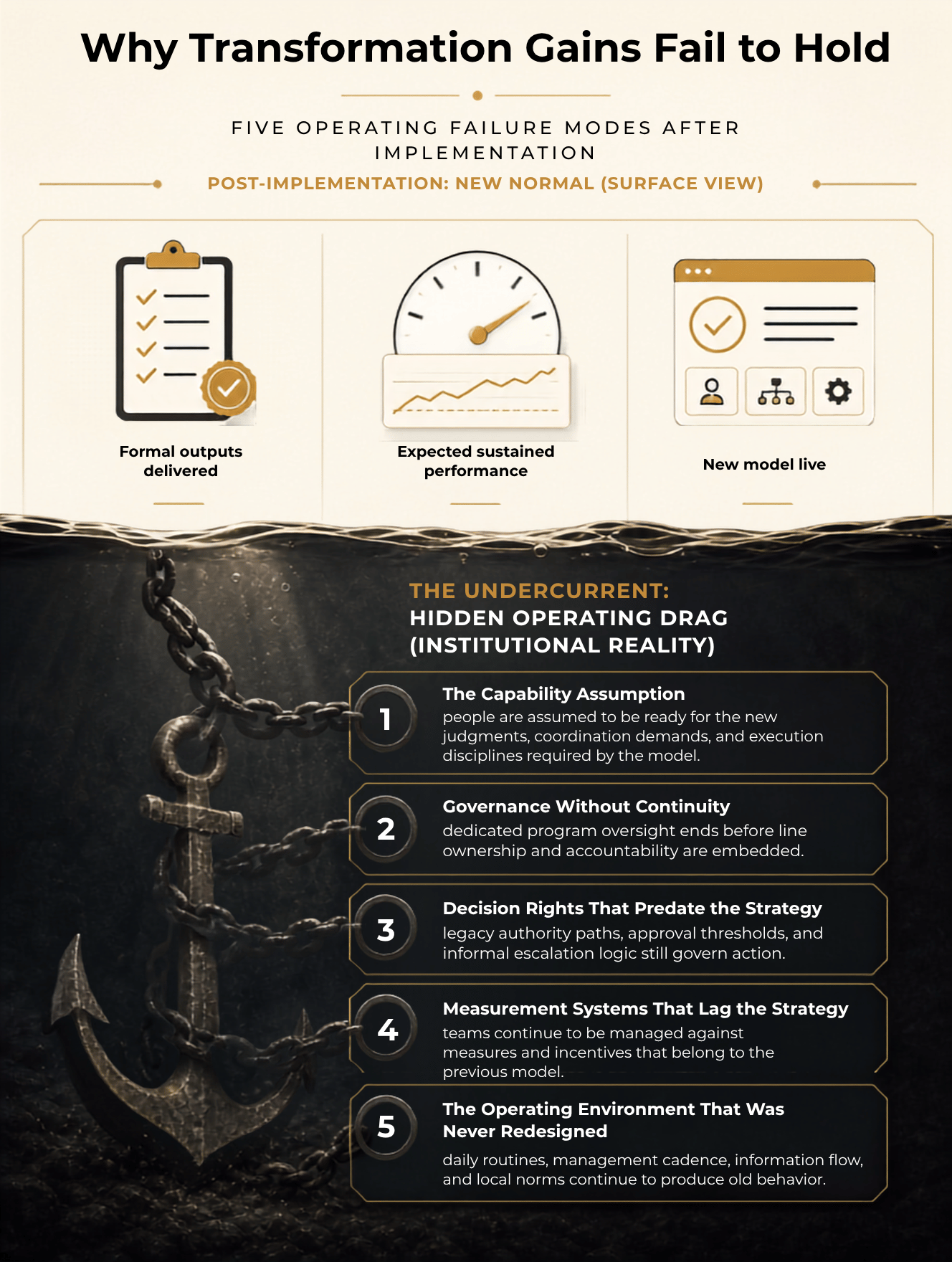
The five operating failure modes that prevent transformation outputs from becoming sustained performance.
FAILURE MODE 01The Capability Assumption
A common failure at the capability level is not a training gap. It is a readiness gap that the program may not have diagnosed before rollout.
Many transformation programs define what new processes, structures, or systems will be deployed and assume that the people expected to operate them are ready to do so effectively. This assumption may go untested before rollout. People who are technically qualified for their existing roles may not be ready for what the new model places on them: different judgment calls, different collaboration patterns, a materially different scope of authority.
A leadership layer that operated well in a centralized model may not have built the experience to lead with the distributed accountability the transformation requires. A frontline team capable of processing a defined workflow may not have developed the judgment to handle the exception cases the new model now escalates to them. These are not addressed by training alone. Training may still be necessary — people need a shared frame, vocabulary, and opportunity to practise before they are expected to perform. But capability must also be embedded into real operating conditions. The article in this series on why training alone doesn’t build organizational capability addresses that distinction directly.
The rollout may proceed on schedule and still perform below expectations. Even where the formal design is broadly sound, the people responsible for operating the new model may not have been assessed and equipped before being asked to run it.
FAILURE MODE 02Governance Without Continuity
Transformation programs require dedicated governance: a sponsor, a program management office, decision forums, and escalation structures that keep the work moving. This is appropriate and necessary. It becomes a structural problem when it is the only governance the new model has.
When dedicated program governance closes, the line organization must be ready to own the new model. What remains after program close is the existing management structure, with its existing accountabilities and its existing habits. If that structure was not explicitly redesigned and prepared to own the new operating model before the program ended, it may not own it effectively when the dedicated program resources are gone. The new processes will be in place. The accountabilities required to sustain them may not be.
McKinsey’s implementation research identifies later-stage governance rigor as one of the distinguishing characteristics of transformations that hold — specifically, maintaining active oversight and deeply embedded transformation-office practices well beyond the initial launch.2 This matters because new systems can be used in old ways. Restructured teams can revert to previous reporting and escalation patterns. Governance forums designed for the transformation may quietly disappear once the program milestone is reached.
The erosion, when it happens, is not always resistance. It may reflect an incomplete transfer of accountability and mandate. Understanding what the engagement process requires at program close — specifically, what governance must be operational before the transformation office disbands — is the difference between a program that sustains and one that doesn’t.
FAILURE MODE 03Decision Rights That Predate the Strategy
Transformations restructure teams, redefine processes, and restate strategic priorities. They less reliably change the formal and informal authority structures governing how consequential decisions actually get made.
Decision rights live in approval workflows, escalation thresholds, budget authority limits, and the informal hierarchy of whose judgment the organization trusts when a conflict arises. An org chart change does not touch any of these. A transformation can declare new decision principles and leave in place the structures that make exercising them difficult in practice.
This risk is especially relevant in transformations that move decision-making responsibility outward or downward — toward regional teams, frontline leaders, or newly empowered operating units. If the formal delegation has been declared but the informal signals still require escalation, people will escalate. Their behavior may be a rational response to the authority environment that remains in place beneath the new model — not a signal that they oppose the direction.
The cost is not only delay. It is the gradual erosion of ownership in the people who were supposed to be running the new model independently.
When empowerment is declared but not structurally enabled, people learn that the declared model and the operating reality are different things — and they govern their behavior accordingly.
This distinction matters particularly in organization restructuring engagements, where authority alignment is as important as structural alignment, and where governance models, RACI frameworks, and role clarity are part of the design scope from the outset.
FAILURE MODE 04Measurement Systems That Lag the Strategy
When an organization changes its strategic priorities, existing scorecards, KPIs, review cadences, and incentive structures often remain active after the priorities change. In that window, managers and teams continue to be evaluated on the metrics that preceded the transformation. People who genuinely support the change may continue to optimize for the measures they are held to.
This should not automatically be treated as a behavior problem. It is a rational response to a misaligned system. A transformation that asks an organization to prioritize customer experience over throughput, while the performance scorecard still rewards throughput, has not actually changed the operating incentive. It has asked people to accept a short-term performance penalty in exchange for a strategic outcome they may or may not believe will be recognized.
McKinsey identifies aligned performance incentives as part of the later-stage implementation rigor that separates transformations that hold from those that don’t.2 Designing the measurement architecture alongside the transformation reduces the risk that teams will continue optimizing for priorities the organization is trying to leave behind. When this is addressed after go-live instead of during implementation design, organizations face the harder task of renegotiating commitments people have already made against the existing system.
FAILURE MODE 05The Operating Environment That Was Never Redesigned
The fifth failure mode provides context for all the others. Even where capability, governance, decision rights, and measurement are addressed, implementation can fail if the surrounding operating environment — the daily structure of meetings, information flows, approval patterns, and informal norms — has not been redesigned to support the new model.
Operating environments produce behavior without requiring conscious decisions. The cadence and structure of a management review communicate which issues warrant senior attention. The information available to a team at the moment of a judgment shapes what judgment gets made. The pattern of what gets escalated, what gets approved without discussion, and what earns recognition from senior leaders defines, in practice, what the organization is actually rewarding — often more reliably than any formal policy statement.
Transformations that change the strategy but leave the operating environment intact are asking people to perform a new role in a context designed for the old one. The formal outputs of the program — the new structure, the updated process, the redesigned workflow — are in place. The environmental context that shapes daily behavior has not changed, and it will keep generating the old behavior until it does.
This is what ROSH’s execution framework places at the center of any implementation design: sustained execution requires that the operating conditions people work within be aligned to the strategy they are expected to deliver.
When they are not, the program succeeds. The transformation does not.
DIAGNOSISWhat Addressing the Failure Modes Requires
The five failure modes rarely operate as isolated issues. A capability gap becomes more damaging when governance is unclear. Measurement misalignment becomes more consequential when decision rights have not moved. An unchanged operating environment can weaken otherwise sound implementation work.
The correct response is not to presume that the original strategy was wrong or that the entire transformation must be restarted. It is also not to assume that the problem sits in one predetermined category.
A post-transformation diagnostic should map four questions:
- What was the strategy intended to change?
- What did the program formally deliver?
- What is now operating in practice?
- Which gaps are strategic, structural, behavioral, capability-related, or measurement-related?
That distinction allows leadership to identify whether the next intervention should address strategic ambiguity, design defects, incomplete implementation, or weak sustainment conditions. The objective is a targeted recovery pathway, not a repetition of the original program.
The five failure modes connect directly to the levers within ROSH’s execution framework and the broader execution enablement approach. They are not a competing taxonomy — they are a post-transformation diagnostic perspective on where each lever may have fallen short:
- The capability assumption
ROSH operating lever — Capability - Governance without continuity
ROSH operating lever — Operating Design - Decision rights that predate the strategy
ROSH operating lever — Clarity + Operating Design - Measurement systems that lag the strategy
ROSH operating lever — Measurement - Operating environment left unchanged
ROSH operating lever — Operating Design, reinforced by management behavior
Before reopening the strategy, leaders should test whether one or more operating conditions remain misaligned. A diagnostic-to-implementation arc designed for post-transformation environments provides that test systematically — and identifies the sequenced interventions required to close the gap between what was formally delivered and what is now actually operating.
COMMON QUESTIONSQuestions Leaders Ask About Sustaining Transformation Gains
Even when the strategic direction and program design are broadly sound, transformation value can erode when the operating conditions required to sustain the new model are not embedded into business-as-usual operations. McKinsey’s research found that while 56 percent of organizations initially achieved most or all transformation goals, only 12 percent sustained those gains for more than three years.2 The same body of research found that 55 percent of transformation value loss occurs during and after implementation.1 This indicates that implementation and sustainment require explicit design attention alongside strategy and program design. Five post-transformation failure modes are particularly useful to investigate: capability readiness, governance continuity, decision-rights alignment, measurement recalibration, and operating-environment redesign. A post-transformation diagnostic maps which of these are active in a given organization, in what combination, and what addressing them requires.
McKinsey’s implementation research identifies three practices that distinguish organizations whose transformation gains persist: they maintain implementation rigor across the later stages of the program, not just the launch; they use the transformation to upgrade talent and achieve people-related goals; and they invest appropriate resources in every stage, including sustaining phases that occur after formal program close. Organizations applying all three practices were 3.4 times more likely to sustain their gains for more than three years.2 The common thread is that the period after formal program outputs are delivered is treated as active, resourced work — not as a maintenance or monitoring phase.
The most useful diagnostic maps four questions against the operating evidence visible in the organization now: what was the strategy intended to change, what did the program formally deliver, what is now operating in practice, and which gaps are strategic, structural, behavioral, capability-related, or measurement-related. That distinction allows leadership to identify whether the next intervention should address strategic ambiguity, design defects, incomplete implementation, or weak sustainment conditions — and to design a targeted recovery pathway rather than restarting the original program. The diagnostic question is not only what went wrong during the program. It is also what remained unaddressed when formal delivery ended.
Sources Cited
1. McKinsey & Company. Losing from Day One: Why Even Successful Transformations Fall Short. McKinsey Global Survey. Cited for: the “fewer than one-third” finding; 55% of transformation value loss occurring during and after implementation; nearly one-quarter occurring during target setting.
2. McKinsey & Company. How to Implement Transformations for Long-Term Impact. McKinsey Global Survey. Cited for: the 56% / 12% sustained-gains gap; the 3.4× finding on later-stage rigor, people-related goals, and full-stage resourcing; later-stage governance engagement and aligned incentives as distinguishing practices.
Start with a post-transformation diagnostic
If your organization has completed a transformation and is not seeing the sustained performance it was designed to deliver, the starting point is understanding which operating conditions remain misaligned.